
"Let's Test the Market" Is Not a Pricing Strategy
Quick Answer: "Let's test the market" means one of two things: the agent hasn't done the analytical work to recommend a defensible price, or they know the price is too high and won't have the hard conversation. Either way, you pay — in carrying costs, in listing freshness, and in lost competitive tension. The test already happened — in the data. A competent agent doesn't need to experiment with your equity.
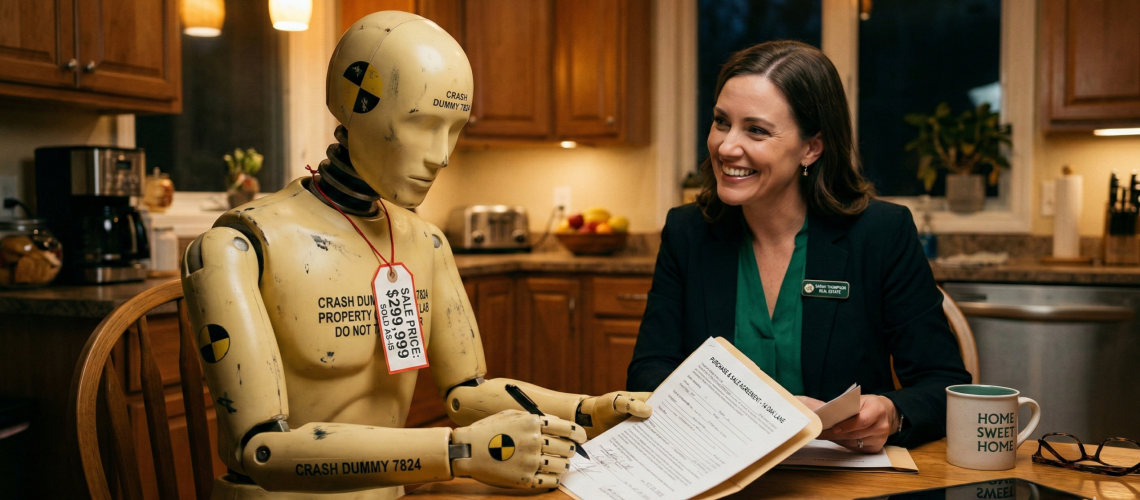
If you're planning to sell your home in 2026, you're almost guaranteed to hear a version of this phrase during a listing presentation. "Let's test the market." Or its cousin: "Let's see what the market will bear." It sounds cautious. It sounds scientific. It sounds like a professional running a controlled experiment before committing to a strategy.
But step back and think about what the phrase actually admits. This is a person who does this for a living. They have access to every active listing, every closed sale, every price reduction, and every days-on-market figure in your area. And after all of that, their recommendation is: let's put it out there and see what happens.
That is not a strategy. It's an admission. We broke down the full argument in a recent discussion — the two scenarios behind the phrase, the carrying cost math, why even a "successful" test might cost you money, and the seven questions that tell you whether you're hiring a professional or a guesser. Listen or read the full transcript here.
The Two Scenarios
When an agent says "let's test the market," the mechanics behind the phrase are almost always one of two things. Scenario one: they haven't done the deep analysis required to give you a defensible number. They have the data access but not the insight — they're replacing rigorous analysis with a shortcut. Scenario two — and this one is more common — is what the industry calls "buying the listing." The agent has done the work. They know your home is worth $589,000. But you want $650,000 because you anchored on a Zestimate. Rather than risk losing the listing by telling you the truth, they agree to "test" your number — then wait 30–60 days for the market to deliver the bad news they should have delivered at your kitchen table.
Both scenarios cost you money. The only question is how much.
The Carrying Cost Math
Testing feels free because you aren't writing a check every morning. But holding a property has a daily burn rate — mortgage, taxes, insurance, utilities, maintenance, HOA, and the opportunity cost of trapped equity. On a $500,000 home, that's roughly $100–$130 per day. On a $700,000 home, $140–$180. A $900,000 home burns approximately $200 per day.
Thirty days of "testing" at $500,000 costs $3,000–$4,000. Sixty days at $700,000 costs up to $10,800. When an agent says "let's test it for a month," translate that to "I'm asking you to pay a $4,000–$5,000 guessing fee."
And that's just the hard cost. After 14–21 days without an offer, your listing starts going stale. Buyers see the days-on-market counter ticking up and assume something is wrong. When you finally cut the price, you end up where the data said you should have started — except now the listing is tainted and you often sell for less than if you had priced it correctly on day one.
Why a "Successful" Test Might Be a Failure
The counterintuitive part: even when the test "works" — you get an offer at the high price — you may have lost money.
A correctly priced home creates competitive urgency. Multiple buyers showing up at the same time push each other upward. The asking price becomes the floor, not the ceiling. That's how homes sell for $30,000–$50,000 over asking in three days. But a test price set at the top of the range scares off the main buyer pool, kills competition, and caps your upside at whatever one uncertain buyer is willing to pay. You'll never know what a bidding war would have netted you.
And then there's the question nobody asks: who buys a home at a test price? Someone whose own agent either didn't recognize the price was high — a competence gap — or knew it was high and didn't protect them. Transaction data from 2018–2024 shows that same-firm deals sold for 6.36% over list while outside-agent deals sold for 8.06% — a 1.7% gap. On a $700,000 home, that's nearly $12,000.
The Seven Questions That Tell You Everything
Before you agree to any pricing strategy, ask the agent sitting across from you:
What is the absorption rate in my specific school district right now? What percentage of active listings have cut their price? How did you arrive at this specific number — walk me through the math? What happens if we don't get an offer in 14 days? How many homes have you sold in this district in the last 12 months? What is your pricing accuracy on your last 10 listings? And if I ask for a price you think is too high, would you push back?
If the agent can't answer the first two from memory, they don't know your market well enough to price your home. If their answer to question four is "we'll reduce the price," they're already planning to fail. And if they won't push back on an unrealistic number, they're an order taker — not an advisor.
What Competent Pricing Actually Looks Like
The premise of "testing the market" is that you need the market to tell you what the home is worth. But agents who track their markets weekly already have the answer. They monitor absorption rates, price reduction trends, neighborhood-level patterns, and pending-to-closed ratios — not quarterly, but every week. They use predictive tools that model probable sale price before the sign goes up.
Our WB3 predictive model achieves 92.2% accuracy across 25 districts and 977 neighborhoods. That's not magic — it's the result of weekly tracking and data investment. And it eliminates the need for testing entirely. But the point isn't that we do this. The point is that this standard exists in the industry. If your agent needs to "test," they haven't invested in the systems that would make testing unnecessary.
The test already happened — in the data. A competent agent translates what the data is saying. A guessing agent experiments with your equity and your time.
Listen to the Full Discussion
This post is the condensed version. The full episode walks through every scenario — the surgeon analogy, the complete carrying cost math at three price points, the ceiling vs. floor pricing dynamic, the buyer-side competence question, all seven questions with what good and bad answers sound like, and the rapid-fire green flag/red flag checklist for agent interviews. Listen or read the full transcript here.
For weekly market data across 41 school districts, visit our Market Intelligence Tool.
Have Questions About Pricing Your Home?
Every home and every market is different — and that's exactly why "test the market" doesn't work. If you want to see what the data actually says for your school district and what a defensible pricing strategy looks like, we're here to walk through it.
We'll personally respond within a few hours. No autoresponders, no sales team — just us.
Or call (484) 259-7910