
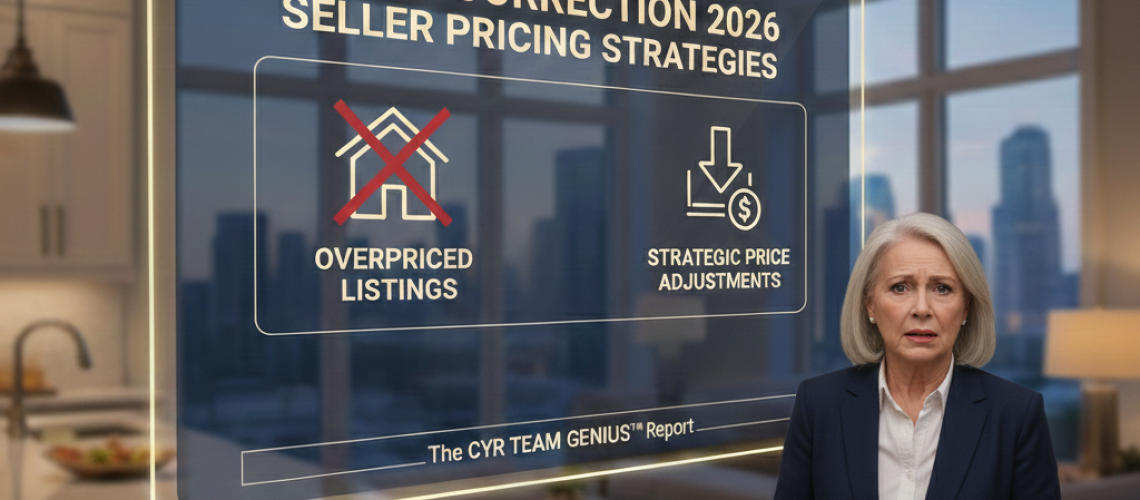

The Silent Correction Trapping 2026 Sellers
Quick Answer: Inventory is under 2 months — technically a seller's market. But 35-44% of sellers are cutting prices and homes are sitting 130-216 days. "Testing the market" by listing high costs sellers $40,000-$80,000 in carrying costs and price reductions. The buyer pool has physically shrunk — a 1.5% rate increase erases $78,000 in purchasing power. Price for the market you're in, not the one you wish you were in.
We broke down the full mechanics in a recent discussion — the silent correction hiding behind low inventory numbers, the testing-the-market timeline that turns ego into a five-figure penalty, the carrying cost math nobody runs before listing, the interest rate squeeze that has physically shrunk the buyer pool, and the local factors compounding the problem from Crozer Health layoffs to storm damage. Listen or read the full transcript here.
The Silent Correction
Inventory is genuinely low — 0.9 to 1.8 months of supply across our districts. By the textbook, that's a seller's market. But the label only applies to the quantity of homes. It does not apply to the quality of the deal a seller can get. Buyers in 2026 have the same data sellers do, and they are refusing to pay 2024 fantasy prices in the 2026 economic reality. A house no one can afford isn't inventory. It's just scenery.
10 Days or 130 Days — No Middle Ground
The data shows an almost entirely binary market. Correctly priced homes sell in under 30 days — sometimes under 10. Overpriced homes sit for 130-216 days. In Avon Grove, the average is 216 days. In Downingtown, 155. In Great Valley and West Chester, 131. And those averages are rising, not falling, even as inventory tightens. The good listings sold quickly. What remains is increasingly stale — overpriced inventory that buyers are refusing to engage with.
The Most Expensive Thought a Seller Can Have
"Let's list high and see what happens — we can always come down." This is the testing-the-market strategy, and the data shows it is the single most expensive mistake sellers make.
Days 1-14 are the golden window. Maximum buyer attention — every serious buyer gets an alert, every agent previews it. If the home is overpriced during this window, the seller wastes their single best opportunity on buyers who look, calculate, and move on. A price drop at day 30 doesn't reset the clock — buyers who already dismissed the listing don't come back. By day 60, agents stop showing it. By day 90, it's stale and lowball offers begin.
The carrying costs are real. A $900,000 home costs $6,450-$9,300 per month in mortgage, taxes, insurance, utilities, and maintenance. Four months of overpricing burns $26,000-$37,000 — before the inevitable price reduction of $20,000-$50,000 or more. The total cost of "testing the market" easily exceeds $40,000-$80,000 compared to pricing correctly from day one. That's a huge price tag on ego.
The $78,000 the Buyer Lost — And You Don't Know It
Sellers focus on comparable sales from 2024-2025. But the buyers looking at their home today are financing at different rates. A buyer qualifying for a $3,000 monthly payment could afford $528,000 at 5.5% interest — but only $450,000 at 7.0%. That's a $78,000 reduction in purchasing power with no change in income, credit score, or down payment. The buyer pool hasn't just become picky. It has physically shrunk. Sellers are pricing for buyers who literally do not exist at that price point anymore.
The Local Factors Nobody Mentions on Zillow
Real estate is hyperlocal, and national headlines miss every local factor that's compounding the squeeze right now. Crozer Health layoffs and calls for criminal investigation into their parent company are creating job insecurity in Delaware County — buyers aren't taking on million-dollar mortgages when a major local employer is in distress. The Route 29 sinkhole in Great Valley adds a "hassle tax" to every showing — 20 minutes of construction traffic that comes right off the offer price. Remote work has softened demand in the Malvern corporate corridor, and the Great Valley School District bargain-hunting a $7.5 million commercial building tells you what corporate demand looks like now.
Late 2025 storm damage turned mature trees from assets into liabilities — buyers are mentally deducting $5,000-$15,000 for tree removal and higher insurance. Sellers in Upper Providence trying to charge the Media Borough walkability premium are getting punished by buyers who know they can't walk to State Street from three miles away. And sellers of 1990s colonials near Downingtown pricing against Applecross new construction are competing against a product they can't match.
The Agent Trap
The most expensive hiring mistake has nothing to do with the house. It's picking the agent who promises the highest price. "Buying the listing" — telling sellers what they want to hear to win the business, then managing price reductions for four months — is one of the industry's worst practices. The best listing presentation isn't the one with the highest number. It's the one with the most accurate number — the one that generates offers in the first 14 days and maximizes your net proceeds instead of maximizing your hopes.
The 92% Question
Our WB3 predictive system tracks 25 school districts and 977 neighborhoods, covering $1.74 billion in appreciation. It has achieved 92.2% accuracy predicting which properties will sell below asking price. If a computer model can predict with 92% accuracy that you're going to have to cut your price — why not just price it correctly from day one and save yourself four months of mortgage payments? Why spend a dollar to make 50 cents?
Listen to the Full Discussion
This post is the condensed version. The full episode walks through every scenario — the complete testing-the-market timeline, the carrying cost math at both price points, the interest rate payment threshold with specific dollar examples, every local factor from Crozer Health to storm damage, the agent selection trap, and the scarcity-versus-commodity argument for why selling now beats waiting for rates to drop. Listen or read the full transcript here.
For weekly market data across 41 school districts, visit our School District Information.
Want to Know What the Data Says About Your Home?
Every home, every neighborhood, every district has its own data story. If you want to see the carrying cost math, the price reduction probability, and the days-on-market pattern for your specific property — we'll walk through it with you. No aspirational pricing. No flattery. Just the numbers and what they mean for your net proceeds.
We'll personally respond within a few hours. No autoresponders, no sales team — just us.
Or call (484) 259-7910