

Why Private Listings Raise Mortgage Rates
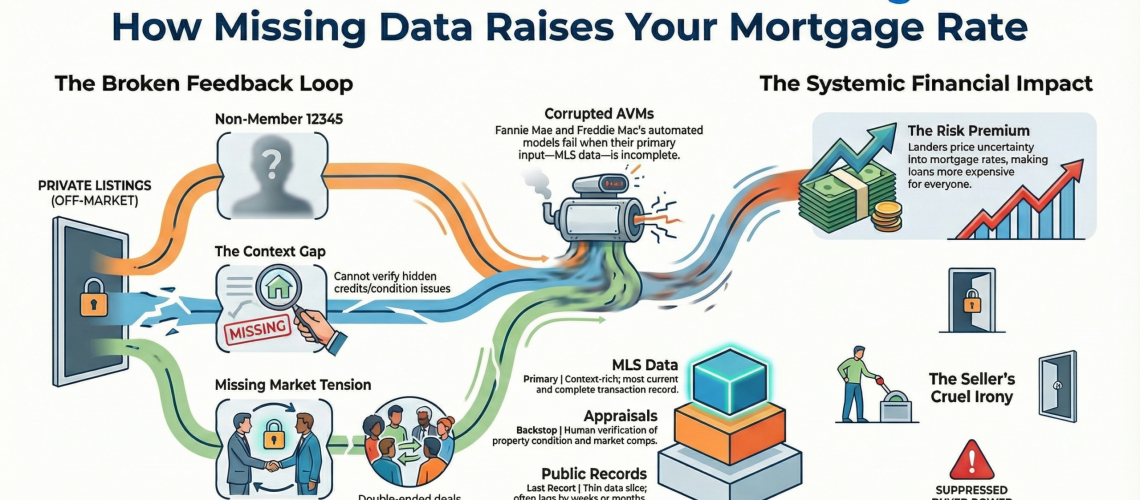
Quick Answer: When an Office Exclusive closes in BRIGHT MLS, the listing agent and office fields are replaced by Non-Member 12345. The appraiser who calls to verify concessions and arm's-length status reaches nobody. That comp enters the automated valuation models Fannie Mae and Freddie Mac depend on — weighted identically to a clean cooperative sale. Degrade enough comps and the models widen their confidence intervals. Lenders price the uncertainty into the rate. Every borrower in the conforming market absorbs the cost. The chain from a private listing in your neighborhood to your mortgage rate is direct.
Parts 1 and 2 of this series established what Coming Soon actually is, why the pricing laboratory narrative collapses, and how the portal capture machine monetizes your listing during the locked window. Part 2 ended with one unanswered question: if this fragmentation keeps scaling — what does it actually cost? This post answers it. The full episode and transcript are here.
The Phone Call That Didn't Happen
Appraisers sometimes call the listing agent after a transaction closes. Not always — but the call happens for a reason. The MLS record shows the sale price. It doesn't show the $20,000 in seller credits that made a $500,000 sale effectively a $480,000 transaction. It doesn't show whether the property had fifteen competing offers or sat privately for six months. It doesn't confirm whether the transaction was arm's length.
The phone call is a quality control mechanism built into the appraisal process. It assumes there is a real, accountable professional to call who has knowledge of the deal. When an Office Exclusive closes in BRIGHT MLS, the system replaces the listing agent and office fields with Non-Member 12345. The appraiser reaches nobody. That transaction enters the comparable sale record — weighted identically to a fully documented, MLS-cooperative sale — with no mechanism to recover the context that determines whether it's actually a reliable comp.
The Double-Ended Unknown
One layer compounds the problem further, and it's the one nobody is discussing. When an Office Exclusive closes as Non-Member 12345, there's no way to know if it was double-ended — one agent representing both buyer and seller. A legitimate comparable sale assumes adversarial negotiation: independent representation on both sides, with genuine friction between a buyer trying to pay less and a seller trying to receive more. That friction is what produces a reliable market signal. A double-ended transaction eliminates it. The agent representing both sides has one incentive: close the deal to collect both commissions. The resulting price may reflect that incentive rather than true market value — and the appraiser has no way to know.
The Data Hierarchy and Where It Breaks
Fannie Mae and Freddie Mac's automated valuation models run on a three-tier data hierarchy. MLS data is the primary input — the richest and most contextual record available. Appraisals are the human backstop, dependent on MLS data quality. Public records are the last resort — county deed records capture only that a transaction occurred and at what price, with no context about condition, concessions, or market exposure, and often lag by weeks or months.
As Office Exclusives increase and transactions migrate to portal-exclusive pre-marketing channels, the primary input degrades. Appraisers work from a corrupted dataset without knowing it. AVMs model a market they can only partially see. The confidence intervals widen. When lenders pool mortgages for the secondary market, investors see the uncertainty and demand a higher yield. That yield demand translates directly into a higher mortgage rate for the buyer on Main Street.
The Cruel Irony for Sellers
A seller pitched an extended Coming Soon period or Office Exclusive is told it will maximize their home's value. What they aren't told: by keeping data off the open market, they're contributing to the environment that raises mortgage rates systemically. A buyer pre-approved for $520,000 at a stable rate can only afford $490,000 when systemic data degradation pushes the national rate up half a percent. The strategy designed to secure a premium price actively restricts the buyer's ability to pay it.
Think of it like car insurance. If half your town stops reporting accidents and settles privately in parking lots, the insurance company loses visibility into actual road risk and raises everyone's premiums. The risk premium is socialized. Every borrower absorbs the cost — not just the people buying the specific off-market properties.
The RealPage Blueprint
The DOJ's RealPage case established the legal precedent. RealPage provided landlords with a common algorithm processing non-public pricing data to produce coordinated rent recommendations. The DOJ rejected the independent decisions defense — establishing that independent actors using a common platform to share non-public data and produce coordinated market effects constitutes structural price coordination regardless of intent. Portals sharing pre-market listing data and buyer behavioral analytics across millions of properties operates on structurally identical mechanics. The DOJ doesn't need a new theory of the case.
What a Different Practice Looks Like
The Cyr Team's practice is documented and operational: 24-hour Coming Soon maximum for quality assurance and buyer preparation only, dual agency treated as a structural conflict of interest rather than a commission opportunity, unrepresented buyers referred to independent agents, referral fees disclosed in the listing contract before the listing goes live. The seller knows the full financial architecture before signing. The revenue consequence of walking away from dual agency is accepted because compromising loyalty to the client is not acceptable. That is the difference between saying you put clients first and building a system that makes it structurally true.
The Question Every Homeowner Should Carry
Every homeowner has a stake in this — not just the ones buying or selling today. Your home's equity relies on a data ecosystem that is currently missing half the picture. If the uncertainty of degraded data is priced into every loan, it suppresses buyer purchasing power — which suppresses the value of every neighborhood in the country.
What is your home worth if the data that determines its value is missing half the picture? What is your mortgage rate if the uncertainty from degraded data has been priced into every loan in the market? And who decided that the public good of a transparent, reliable, cooperative marketplace was a good enough reason to build something different?
Listen to the Full Episode
The full episode walks through every mechanism in depth — the complete appraiser verification process, the AVM confidence score mechanics, the secondary market yield demand chain, the full RealPage precedent analysis, and the series closing questions. Listen or read the full transcript here.
For the complete series from the beginning: Part 1 | Part 2 | Series Hub
For weekly market data across 41 school districts, visit our Market Intelligence Tool.
Thinking About Listing Your Home?
If you want to understand what a fiduciary-first listing approach actually looks like in practice — we're here.
We'll personally respond within a few hours. No autoresponders, no sales team — just us.
Or call (484) 259-7910