
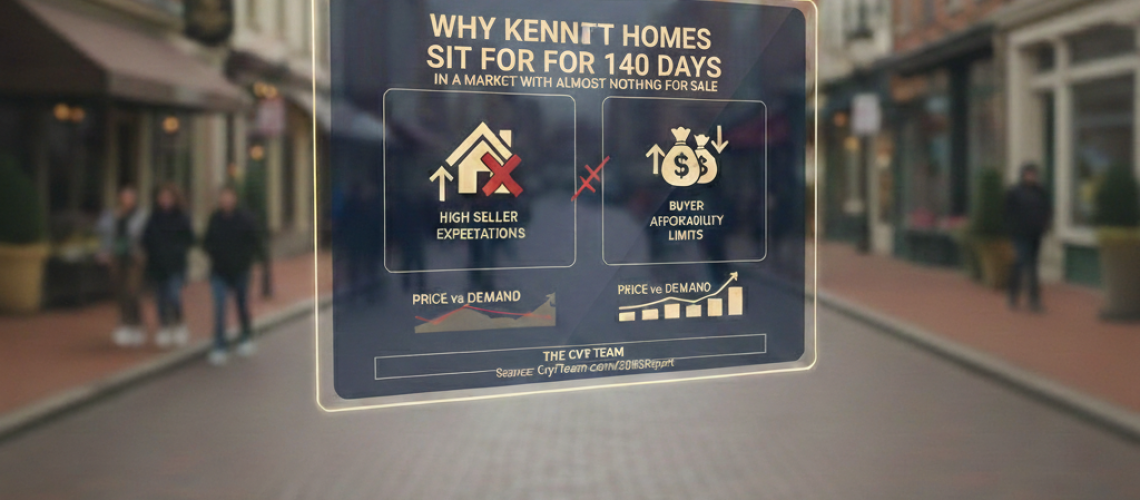

Why Kennett Homes Sit for 140 Days
Quick Answer: Kennett Consolidated has under 50 active listings and about two months of supply — but homes average 140+ days on market. The explanation: luxury estates up to $3.25M drag the average up while the real middle market holds at $580K. Buyers priced out of West Chester are finding breathing room here, and $200 million in institutional investment from Penn and the school district is putting a floor under values. The question is whether this is the last window where Kennett is still affordable.
Here's a market that shouldn't exist, at least not according to the textbook.
The Kennett Consolidated School District has fewer than 50 homes for sale. About two months of inventory. In any normal scenario, that means homes sell fast and sellers name their price.
Instead, homes are averaging 140 to 152 days on market. Up to 22% of sellers are cutting prices every week. And buyers — far from panicking — are negotiating with confidence.
We broke this down in a recent deep dive using four weeks of data from January through February 2026. If you want the full discussion, listen or read the transcript here. Below is the condensed version.
Two Markets in One Zip Code
The median price in Kennett held rock steady at $580,000 throughout January and into February. That's the real market — the typical family home.
But the average price bounced between $796,000 and $820,000. That's a $200,000+ gap, and it explains nearly everything. Luxury estates priced up to $3.25 million pull the average way up — and while those properties sit for months, they drag the days-on-market number with them, making the entire district look stagnant.
The danger: sellers see the $800K average and price their median homes accordingly. Buyers see the $580K reality and refuse. The result is that 16-22% of listings take price cuts every week — in a market with almost nothing for sale.
The Institutional Floor
What keeps that $580K median from dropping? Roughly $200 million in institutional investment. Penn's Bolton Center is undergoing a $94 million expansion — a state-of-the-art veterinary and agricultural research facility that's bringing PhDs, specialized researchers, and high-income professionals into the buyer pool. The Kennett Consolidated School District just adopted a $94 million budget, investing in counseling programs, student support, and infrastructure.
When the university and the school district are both doubling down with nine-figure bets, that puts a floor under property values. It also shapes the buyer profile — these are analytical, long-term buyers. Tenure money, not flip money. They don't waive inspections. They don't panic-bid. They wait for value.
The Strategic Alternative
One client — Brittany B. — described getting "chewed up" in West Chester and Garnet Valley, where same-day bidding wars and waived contingencies are standard. She moved her search to Kennett and found a home in three to four months.
She didn't settle for Kennett. She escaped the insanity to get similar quality — strong schools, historic charm, community character — without the ulcer. That pattern is repeating. Buyers priced out of West Chester's $692K median and Garnet Valley's volatile pricing are finding breathing room in Kennett at $580K.
But there's a critical nuance: the historic borough homes don't follow the 140-day average. Pristine Victorians on walkable streets in the borough move fast. That sub-market plays by West Chester rules. The 140-day leverage exists in the subdivisions and outlying areas.
The Walkability Factor
The approval of the Bontrager Walk along Birch Street seems small next to $94 million construction projects. But it signals where Kennett is heading. Real estate in 2026 is shifting from "big house on a hill" to "can I walk to get a coffee?" Physically connecting neighborhoods to the borough's restaurant scene, creamery, and mushroom festivals turns houses into lifestyles — and lifestyles command premiums.
New Construction Forces Honesty
Developments like Longwood Preserve and Magnolia Place add complexity. A brand-new townhouse at $600,000 sets a benchmark that a 1990s colonial at $650,000 — one that needs a roof — has to compete with. New construction forces the resale market to price honestly based on condition, not aspiration.
What This Means for Buyers
If a listing has been sitting for 60+ days, you have leverage. Ask for closing cost credits. Keep your inspection contingency — something you can't do in West Chester. Don't insult with a lowball, but recognize that a seller at 90 days is tired and ready to listen.
If you want a historic borough home, throw the DOM chart away. Act fast — Tuesday viewing, Wednesday offer. That sub-market is insulated from the broader slowdown.
What This Means for Sellers
Price to the median, not the average. $580,000, not $800,000. If you're the best-priced home out of 48 listings in the district, you'll get the West Chester overflow buyers who are tired of bidding wars. If you're the most expensive, you'll be ignored — and you'll join the 22% taking price reductions after four months of silence.
The Last Affordable Window?
At $580K, Kennett is still accessible compared to the rest of Chester County. But the forces are converging — $200 million in institutional investment, growing overflow from West Chester, walkability improvements, the hotspot label. First it was the Main Line. Then West Chester. The data suggests Kennett is next.
The messy data — the 140 days, the price cuts, the mixed signals — that's what a market in transition looks like. And transitions are where the opportunity lives. If the market was perfect, there would be no deals.
Listen to the Full Discussion
This post is the condensed version. The full episode — "Why Kennett Homes Sit for 140 Days" — walks through all four weeks of data, the borough vs. subdivision split, the Bolton Center effect, new construction dynamics, and specific strategy for both buyers and sellers. Listen or read the full transcript here.
For weekly market data on all 41 school districts, visit our Market Intelligence Tool.
Want to Know Where Your Kennett Home Fits?
If you'd like to talk through your specific situation, we're here — just tell us a little about where things stand.
Whether you're buying into Kennett or thinking about selling, the strategy depends on which sub-market you're in — historic borough, subdivision, or new construction. Let's look at the real data for your specific neighborhood.
We'll personally respond within a few hours. No autoresponders, no sales team — just us.
Or call (484) 259-7910