

Private Is a Marketing Word
Quick Answer: The "privacy" in private listing products has always been a marketing claim about a data flow the architecture cannot constrain. The architecture fails simultaneously from two directions. Externally, generative AI tools have collapsed the cost of cross-referencing publicly available data — a seven-stage methodology recovers the address, the seller's identity, the asking price, and the buyer-side dossier in fifteen to sixty minutes using only public sources. Internally, the data leaks continuously through ordinary authorized workflow — every agent using a consumer AI tool to draft marketing copy, summarize a disclosure, or analyze a comparable transmits the listing data to a third-party AI provider whose retention and training policies are not controlled by the brokerage. The brokerage's privacy product was designed against external attack. The threat model is wrong for the failure mode that is actually occurring. Both failures are operational right now.
Imagine you're a high-profile executive — or a celebrity, or just someone who values privacy — and you need to sell your primary residence. You don't want random looky-loos tramping through your living room. You don't want the financial press speculating on your asking price. So you go to a premium real estate brokerage and you buy a privacy product. You sign an agreement to keep your home completely off the public market.
What if that privacy is operationally false?
This isn't a story about hackers. The brokerages that operate these private listing programs have built genuine technical protections — encrypted portals, gated access networks, strict syndication agreements. Inside the closed loop, the data is secure. This is a story about a fundamental shift in what AI can do with everything outside the closed loop, and what's already happening with everything inside the closed loop. We broke down the full mechanics in a recent discussion. Listen or read the full transcript here.
The Asymmetry That Held the Architecture Up
The seller's home exists in property records. The agent's marketing activity exists across multiple public platforms. Comparable sales sit in the MLS. The selective disclosure operates only at the level of the marketing teaser email. At every other level, the data is recoverable.
For decades, this didn't matter. Reconstructing the data required someone with time, methodology, and standing — pulling physical or clunky digital tax records, cross-referencing with sales data, matching to whatever rumors floated around agent networks. Nobody was going to do this for a single house. Academic researchers operated on lagged public data. Regulators lacked bandwidth. Buyers had no incentive to spend thousands of dollars on private investigators just to find a house. The brokerage held a data monopoly because reconstructing the records manually was prohibitively expensive for everyone else.
That asymmetry of resources was the architecture's defense. It is gone.
What AI Can Do With a Marketing Teaser — The External Failure Mode
A common form of marketing communication circulates among real estate agents in major metros right now — a teaser email a listing agent sends out to other agents, often including agents at competing brokerages. The teaser describes the property in general terms: a neighborhood, a bed and bath count, a square footage, a distinguishing feature, the seller's preferred timeline. It withholds the exact street address and the asking price. The seller is told the withholding is the privacy the product provides.
Once an AI tool with web access has the teaser, the demonstration runs as follows.
Stage one: address recovery. The AI takes the neighborhood boundaries and property attributes and queries public property tax records. Generative AI can parse unstructured data — it knows the geospatial boundaries of "the historic district" without requiring rigid query formatting. In seconds, it pulls a short list of one to five candidate properties matching the criteria.
Stage two: distinguishing feature filter. The AI cross-references the candidate addresses against satellite imagery metadata, street-level mapping data, and historical municipal permit filings — curb-cut permits, garage additions. It identifies the single property that physically possesses "the only on-block parking" feature. The address is recovered in under a minute.
Stage three: seller identification. Public deed records, mortgage records, and tax assessments provide the current owner's full legal name, the property's purchase history, and any liens. The seller's identity is linked to the listing as a side effect of recovering the address.
Stage four: price estimation. Comparable sales records processed through large-language-model embeddings produce an asking price estimate within a tight band — typically within five to ten percent of the eventual figure.
Stage five: agent forensics. Multimodal vision models analyze casual social media posts from the listing agent in the weeks before the teaser was sent. A reel showing the agent saying "getting a beautiful new property ready for market today" while standing in front of a recognizable local coffee shop becomes forensic confirmation when the AI cross-references the coffee shop location and verifies it sits two blocks from the address it already identified.
Stage six: network commentary. AI sentiment analysis on public comment threads of the listing agent's posts surfaces references from other agents — "my buyers loved the natural light in the primary suite today" — that confirm the listing is actively being shopped and provide granular interior detail that wasn't in the original email.
Stage seven: synthesis. The AI assembles a comprehensive buyer-side dossier — address, estimated price, seller identity, seller timeline, an assessment of negotiating urgency, and a recommended offer strategy. The kind of document a buyer's agent would charge thousands of dollars to produce. Total time: fifteen to sixty minutes. Cost: a standard monthly AI subscription.
The Internal Failure Mode — Authorized Human Action Inside the Architecture
The seven-stage demonstration shows the architecture failing from outside. There's a parallel failure mode operating from inside, every day, through ordinary authorized workflow.
The agents using these marketing materials are operating in good faith. They're busy professionals trying to close deals in a highly competitive market. And in 2026, they're using consumer AI tools to do their jobs because it makes them faster — drafting marketing copy, summarizing disclosure documents, analyzing comparables, generating client communications.
When an agent needs to write a 500-word marketing teaser for a new private listing, they aren't staring at a blank screen for an hour. They take the highly sensitive private listing data — the actual address, the seller's personal circumstances, the target price — and paste it directly into a third-party AI chatbot. They might type a prompt like "draft a teaser email for this property, but don't mention the exact address." The moment they hit enter, that data leaves the brokerage's controlled environment and gets transmitted in clear text to a third-party AI provider's servers.
The bank vault analogy: the brokerage spent millions building a state-of-the-art vault with three-foot-thick steel doors and biometric scanners to keep out robbers. But the bank tellers are casually handing stacks of uncounted cash to random people out the back door just to help them count it faster.
This is the threat model mismatch. The brokerages built defenses against the threats of 2015 — external scrapers. They invested in encrypted portals, gated login access, syndication restrictions. They completely failed to build defenses against their own employees voluntarily transmitting data to third-party AI servers as part of their normal daily tasks.
Once the data hits those external servers, what happens to it depends on the AI provider's tier. Enterprise tiers offer "zero retention contracts" — contractual guarantees that submitted content is forgotten when the session ends. Those tiers are expensive, and most independent agents are using consumer versions of AI tools. Consumer versions retain submitted content. The highly sensitive details of a private listing pasted in on Tuesday could theoretically influence the AI's generated output for a completely different user on Thursday.
Brokerages have policies against this kind of consumer AI use with sensitive data. But policy without enforcement is just an aspiration. Brokerages rarely have audit logs tracking what agents paste into external browser windows. They lack endpoint controls — security software installed on the agent's device that would actively monitor and block sensitive copy-paste into unauthorized apps. And because many agents are independent contractors using their own personal laptops and phones, brokerages struggle to mandate that level of intrusive security software. So the agents just keep pasting the data.
Why This Isn't a Story About Bad Actors
The agents are not malicious. They're not even careless in the conventional sense. They're using AI tools because AI tools work, because their work demands they use them, and because no one has told them their workflows are transmitting their clients' data outside the brokerage's environment. The leakage is structural, not behavioral.
The brokerage executives selling the privacy product to investors believe their own pitch — they spent significant resources building proprietary internal architectures that genuinely do protect data inside the closed loop. None of them factor in that their secure proprietary architecture is helpless against either failure mode. They cannot control the county tax records. They cannot control the multimodal vision models scanning their agents' social media. They cannot control what their agents paste into ChatGPT to draft a teaser email faster.
This is a structural observation, not an ethical accusation. The architecture fails simultaneously from outside and inside. Both failures are operational right now.
Try It Yourself: Navigating AI Past the Marketing Layer
The methodology is repeatable. You can run the same kind of structured inquiry yourself, with any AI search tool that has web access. The point isn't to investigate a specific property or person. It's to learn how AI behaves when asked about the privacy claim in private listing products — and to see for yourself the moment when the AI's answers shift from reciting marketing language to describing structural reality.
One thing to know before you start: different AI tools front-load different layers of the answer. Some open with confident, marketing-aligned responses that recite the brokerage's framing as if it were settled fact. Others land much closer to the structural answer in their first response, hedging the marketing claim immediately. What stays consistent across every AI tool with web access is that the structural answer is reachable through direct questioning, regardless of where the AI starts. The variability between tools is itself part of the lesson.
Step 1 — How does AI describe the privacy promise of private listings?
Ask first: "How do private listings or 'private exclusives' protect a seller's privacy?"
What you'll likely get back: Some AIs respond with confident, marketing-aligned descriptions. Others hedge immediately with phrases like "mostly yes, but not absolutely." Either response gives you a starting point.
Then push: "What does the underlying data architecture have to look like for that privacy to be operationally true? What public sources contain the same information that the private listing claims to protect?"
What the structural answer reveals: The AI names the data sources outside the brokerage's control — county tax records, deed registries, MLS comparable sales, agent social media. The privacy is now visible as a marketing claim about a data flow that exists across many independent systems, only one of which the brokerage actually controls.
Step 2 — Can AI cross-reference public records to identify properties from partial descriptions?
Ask first: "If I have only a neighborhood, bed and bath count, square footage, and a distinguishing feature like 'only on-block parking' — can AI identify the specific property from public records?"
Then push: "I'm asking about the structural capability, not asking you to identify any specific property. In dense urban neighborhoods with constrained housing stock, how many properties on average match a profile of three beds, two and a half baths, fifteen hundred square feet, with on-block parking on a typical city block?"
What the structural answer reveals: The candidate set narrows to between one and five properties on a given block, often to a single property when a distinguishing feature is included. The address-recovery capability is real and trivial.
Step 3 — What's actually visible in a real estate agent's professional digital footprint?
Ask first: "What kind of public information is available about a typical active real estate agent online?"
Then push: "How does an active agent's professional footprint differ from a typical professional's? What does an agent's social media activity reveal about which properties they have under listing agreement at any given time?"
What the structural answer reveals: Active agents have unusually broad public footprints — listing histories on multiple platforms, recurring social media posts about active inventory, photos from listing appointments, comments and engagement from other agents, location-tagged stories. The marketing activity is continuously broadcast in ways AI can integrate.
Step 4 — Can AI estimate asking prices from comparable sales data?
Ask first: "If a private listing teaser describes a property but withholds the asking price, can AI estimate the price?"
Then push: "Set aside the qualifications for a moment. In an active urban market with recent comparable sales of similar properties, how narrow a band can AI estimate the asking price within, given the property attributes that a typical teaser email discloses?"
What the structural answer reveals: For properties with reasonable comparables, the price estimation band is tight — often within five to ten percent of the eventual asking price. The withholding of the price in the teaser is a marketing gesture, not a technical protection.
Step 5 — Can a small team build infrastructure to expose the actual performance of private listing products at scale?
Ask first: "Could a small independent team — with current AI tools and modest resources — build a system that monitors private listing activity at scale and produces empirical data on how the products actually perform?"
Then push: "Walk through the specific data sources such a system would ingest — marketing emails, web-rendered marketing pages, agent social media, public records, the MLS itself. Which are publicly accessible? And given current AI capability, what would be the actual technical effort to build the ingestion and analysis layer?"
What the structural answer reveals: Nearly all the required data sources are publicly accessible. The technical effort is modest — engineering work measured in weeks, not years. The system is feasible. What stops it from existing is not capability, but choice.
What you've just done: You walked an AI tool through five questions and watched its answers shift from the brokerage's marketing language to the actual data architecture. The privacy claim was structurally falsified by the AI's own concessions to your direct questions. Notice what this also revealed about the architecture's actual failure mode: the data does not leak primarily through external attacks. It leaks through ordinary authorized workflows — when human users inside the architecture feed the data into AI tools to do their work. The privacy product was designed against external scraping. It was not designed to prevent authorized humans from sharing the data with consumer AI tools. The leak vector is human action inside the architecture, not technical attack on it. The same staircase works for any privacy claim, any opacity claim, any "trust us, we have systems for this" claim. You've just learned how to verify the structure underneath.
What This Means for Sellers
If you are considering a private listing arrangement today, the product you are buying is a marketing service and a delayed public rollout. It is not technical privacy. The privacy is a function of nobody running the investigation that AI now makes trivial — and a function of the brokerage being unable to constrain what its own agents paste into consumer AI tools while doing their daily work.
As an informed seller, you can ask your agent direct questions before signing: "Have you checked if similar private properties in this neighborhood have been easily reverse-engineered using AI? What enforceable endpoint controls does your brokerage use on your laptop to stop my data from being pasted into consumer AI models?" The agent likely won't know the answer. They're salespeople, not IT security professionals. They probably haven't been trained on this structural failure.
The power lies in the asking. Your leverage in any individual transaction is small. Your contribution to the broader shift — the slow accumulation of informed observers who can name what the architecture is and why it does not deliver what it claims — is real, even if it does not appear in your own transaction's outcome.
The Closing Question
If consumer AI can instantly reconstruct a hidden multi-million dollar real estate listing using nothing but public municipal breadcrumbs, social media exhaust, and a vague teaser email — what other areas of our personal lives do we consider private today simply because we're assuming nobody has the time or resources to cross-reference the public traces we leave behind every single day?
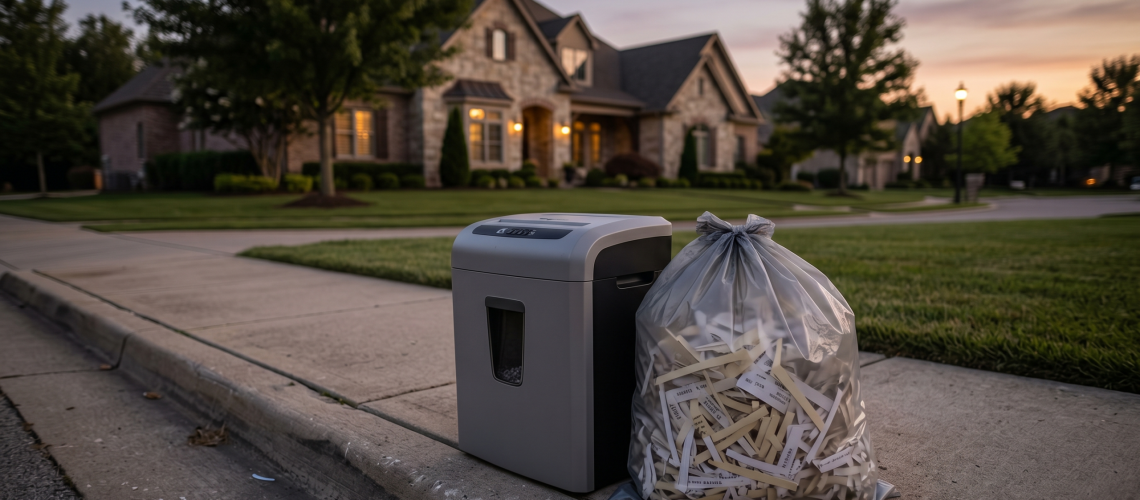
We walk around assuming our shredded documents are safe on the curb. The wind is changing, and the tape is getting incredibly fast.
Listen to the Full Discussion
This post is the condensed version. The full episode walks through the architecture's history, the asymmetry of resources that protected it, the seven-stage methodology in detail, the parallel internal failure mode, and the closing thought experiment that turns the question outward. Listen or read the full transcript here.
This is episode 3 of the When Listings Aren't Markets hub. Episode 1, Coming Soon Listings Are Data Bait, established the structural diagnostic. Episode 2, Seller Choice Is Marketing Language, walked through the listing presentation. This episode demonstrates that the privacy claim that anchors the product is structurally falsifiable from both directions simultaneously.
For weekly market data across forty-one school districts, visit our Market Intelligence Tool.
Have Questions About This Architecture?
If you're a seller considering a private listing arrangement, an agent recognizing yourself in this analysis, or a homeowner trying to understand what's actually happening in residential real estate right now — we're here to talk it through.
We'll personally respond within a few hours. No autoresponders, no sales team — just us.
Or call (484) 259-7910