
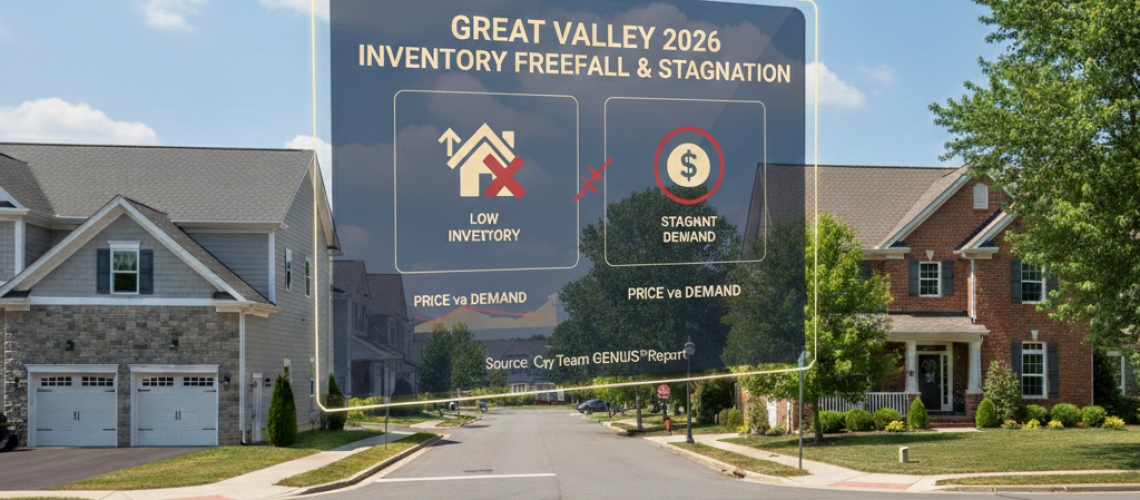

Great Valley — Inventory Freefall Meets Stagnation
Quick Answer: Great Valley dropped from 60 to 43 active listings in under a month, yet homes are sitting 131 days and 38% of sellers have cut their price. It's a split market — correctly priced homes sell in 30 days, overpriced homes sit for months. The listed value and the real value are drifting apart. A silent correction is happening in plain sight.
The numbers are at war with each other. Great Valley lost 28% of its active inventory in less than a month — from 60 listings on January 9th to just 43 by February 6th. That should mean a blazing seller's market. Instead, homes are sitting an average of 131 days and nearly four out of ten sellers have had to cut their price.
We broke down the full paradox in a recent discussion — the standoff between seller ambition and buyer discipline, the four distinct lifestyle nodes, the infrastructure signals hiding in local news, and why days on market tells you the story the price tag is trying to hide. Listen or read the full transcript here.
The Split Market
This isn't one market. It's two. Homes priced correctly from day one — at today's market value, not the seller's dream value — disappear in 30 days or less. The 43 remaining listings are disproportionately the ones that overshot. They're the stale inventory, sitting at 130+ days while sellers slowly realize their pricing strategy was fundamentally wrong.
The 38% price reduction rate is the truth serum. In a truly hot seller's market, you see bidding wars and escalation clauses. You don't see four out of ten sellers waving a white flag. The initial ask and the real value are drifting apart — what looks like a $900K market on the surface is quietly correcting underneath.
The $600K Gap
The median price sits around $899K. The average is $1.5M. That $600,000 spread tells the story of a district that spans $260K condos and $5.475M estates in the same data set. Multi-million-dollar horse farms in Willistown and historic properties in Charlestown pull the average far above what a typical family will pay. For a four-bedroom colonial, the median is the realistic number.
Four Lifestyle Nodes
Malvern Borough — walkable village, restaurants, SEPTA rail to Center City, the Main Street premium. You're trading square footage for lifestyle. East Whiteland and Paoli — the corporate corridor and transportation hub, newer developments, commuter convenience. Willistown — horse country, conservation easements, long driveways where you can't see the house from the road, buying land and silence. Charlestown — bucolic, preserved open space, privacy, and a 15-minute drive to a gallon of milk.
Each one attracts a different buyer, operates at a different price point, and moves at a different pace. The district average masks all of it.
The Infrastructure Signals
Three local stories tell you more about Great Valley's future than any listing price. The 2012 Turnpike ramp that fueled billions in corporate growth and created the demand pipeline that still drives today's prices. The Hampton Inn listed for sale — a proxy for whether smart money believes business travel to Malvern's corporate centers will continue. And the school district buying a commercial office building for $7.5M instead of building new — fiscal discipline that keeps taxes stable and attracts buyers.
Top 1% math and science rankings at Great Valley High School create a moat around property values that holds even in downturns. That's the floor beneath the volatility.
The Buyer's Edge
131 days on market is massive leverage. You do not need to waive inspections. You do not need to overbid. Listings sitting 60+ days — especially ones with price reductions already on the record — are sellers running out of patience in a market with no other buyers knocking. The list price is an opening bid. The silence is your negotiating partner.
But don't assume every house is a sitting duck. Well-priced homes in Malvern Borough and the hot pockets still move fast. The 131-day average is dragged up by overpriced inventory. Be discerning.
The Seller's Reality
You have one ace — there are only 43 listings. You are genuinely scarce. But scarcity only works if you price at today's value. List at your 2022 neighbor's sale price plus 10% and you will join the 38% cutting their price at 90 days while buyers assume something is wrong with your house. Be the most attractive option on a very short menu. Don't overplay the hand.
The Silent Correction
If nearly 40% of the market has to cut prices to find a buyer, what is the real market value? The headlines say prices are high. The ground truth is that prices are being negotiated down, listing by listing, month by month. The sticker price is an illusion — or at least an optimistic opening bid. Days on market is the number that tells you the story the price tag is trying to hide.
Listen to the Full Discussion
This post is the condensed version. The full episode covers every data point, all four lifestyle nodes, the infrastructure deep-dive, buyer and seller strategies, and the silent correction thesis. Listen or read the full transcript here.
For weekly market data, visit our Great Valley district page or explore all 25 districts in our Market Intelligence Tool.
Want the Numbers for Your Street?
A Malvern Borough townhouse and a Willistown horse property aren't in the same market. If you'd like a custom appreciation report for your specific neighborhood, we're here.
We'll personally respond within a few hours. No autoresponders, no sales team — just us.
Or call (484) 259-7910