

The Appraisal Is Becoming a Dataset
Quick Answer: UAD 3.6 turns the home appraisal from narrative commentary into structured data. Which format your appraisal uses right now depends on your lender, the appraiser still develops the opinion of value, and the AI claims around the new format come from vendors. For sellers, the most useful step is a specific, accurate record of improvements: year, item and scope.
For decades, a home appraisal read like a short story. The appraiser walked the property, took notes, and wrote commentary explaining why the home was worth what it was worth. A well-kept older roof could earn a paragraph. That narrative approach is on its way out, replaced by UAD 3.6, the Uniform Appraisal Dataset standard from Fannie Mae and Freddie Mac. We walked through it in a recent discussion. Listen or read the full transcript here.
The Appraisal Is Now Mostly Fields
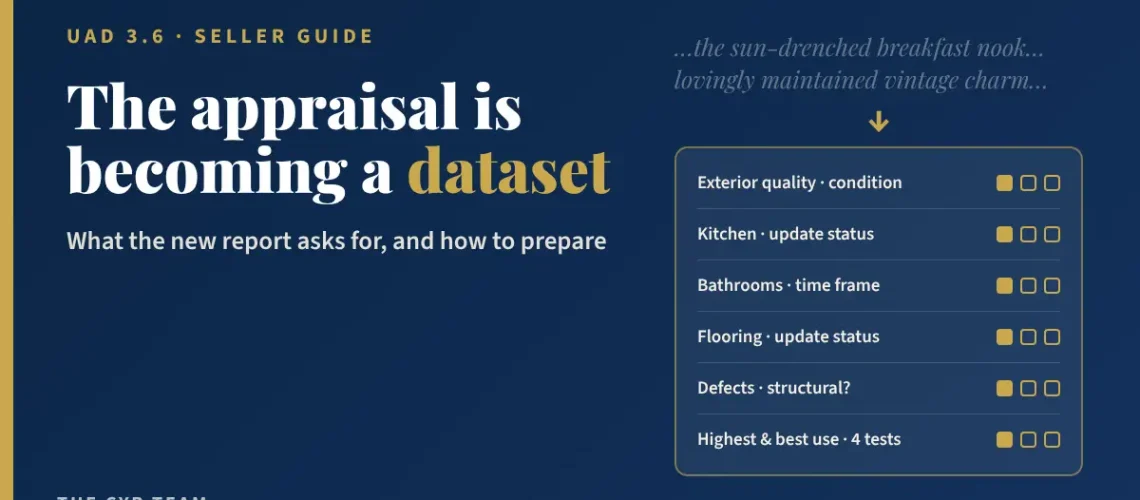
The redesigned Uniform Residential Appraisal Report replaces the static forms, such as the 1004, with a dynamic report that adapts to the type of property. Information that used to live in a paragraph now goes into discrete data fields. In the sample reports the agencies published, the appraiser gives separate quality and condition ratings for the exterior and the interior. For every kitchen and bathroom, the appraiser records not updated, partially updated or fully updated, with a time frame. A defects table notes whether each item affects soundness or structural integrity, and four highest and best use tests are answered yes or no. The appraiser still researches the market, analyzes the comparables and develops the opinion of value, which is NAR's point. The computer is not setting the value. The appraiser's judgment simply has to fit into the fields.
Which Format You Get Depends on Your Lender
The mandate date was November 2, 2026, tied to when the report is submitted to the agencies' data portal, not to when the loan application was taken. On September 30, the agencies announced a temporary exception for approved lenders that could not finish implementing in time. According to trade press reporting, those lenders can keep submitting legacy UAD 2.6 reports through May 19, 2027, with reduced portal functionality from March 1, 2027, and UAD 3.6 becomes mandatory on May 20, 2027. FHA has announced it is adopting UAD 3.6 without a mandatory date, and the November 2 date should not be assumed for VA or USDA loans.
The practical result is that some conventional appraisals are on the new format and some are on the old one. Ask the lender early: which appraisal report format are you ordering, and how much time should we allow? Longer visits, higher fees and slower turnaround have circulated in lender webinars. Fannie Mae, Freddie Mac and NAR have not confirmed fee increases, and NAR says only that the property visit may take longer.
What Is Established About AI, and What Is Claimed
UAD 3.6 was not created specifically to enable AI in lending. But a structured, machine-readable data layer is arriving in the same year as formal rules for AI. The Appraisal Standards Board adopted Advisory Opinion 41 on April 23, 2026, covering use of technology in appraisals, including automated valuation models, statistical software and generative AI. Fannie Mae published Lender Letter LL-2026-04, a governance framework for lenders' use of artificial intelligence and machine learning.
Beyond that, the AI story is largely vendor marketing. Vendors report more than 70 new data fields and say the structured format suits automated review. Some say their systems can evaluate condition from listing and inspection photos and flag mismatches with the appraiser's rating, and that this reduces bias. Those are claims, not measured results. Some appraisers worry that automated flags raise their workload and liability, because errors become discrete, checkable mismatches instead of vague disagreements in a narrative.
Specific Facts Beat Adjectives
“Updated throughout” tells a machine-readable system nothing. A year, an item and a scope of work does. For example: 2023, kitchen remodeled with new cabinets, quartz counters and stainless appliances. The seller's best contribution is facts, including the negative ones, and the appraiser does the analysis. An approximate year is fine, and a line can be left blank if you do not know it. Leaving it blank is better than guessing at a year you cannot support.
The Cyr Team gives sellers a Property Improvements Log during listing prep to gather those facts in one place. It has seven sections: major systems and exterior; kitchens and bathrooms; flooring and paint; additions and layout changes; safety and outdoor features; other updates; and attached receipts and warranties. For each item the seller records the year, the material and who did the work. It is designed to agree with the Seller's Property Disclosure and does not replace it.
There is a longer-term angle too. Everything placed on the MLS today becomes future market data, because the next appraiser relies on what was preserved. The way a kitchen remodel is documented now may become the record read when someone appraises the house next door years from now.
Additions and Accessory Units Get Specific Rules
UAD 3.6 reports highest and best use test by test, including whether the present use is legally permissible under zoning and deed restrictions. Conventional loans allow a maximum of four units including accessory dwelling units. For an illegal accessory unit, such as an unpermitted basement apartment, the appraiser must find at least two comparable sales with the same illegal use. Whether a particular space is legal is a question for local officials and an attorney, not the appraisal form.
The Contract Price Is Not the Value
A signed contract sets a price between a buyer and a seller. The lender relies on the appraisal. If a home is priced beyond what comparable sales and documented facts can support, the sale can stall at the appraisal. A reconsideration of value can be requested, and many in the industry expect it will take detailed support for why each comparable is stronger than the appraiser's. That is an expectation, not a documented result, and it is one more reason to price to the evidence from the start.
The Bottom Line
The appraisal is becoming a dataset. Ask which format applies, give the appraiser specific and accurate facts, and treat the AI headlines as vendor claims until they are shown otherwise.
Listen to the Full Discussion
This post is the condensed version. The full episode covers the new report field by field, the rollout timeline, the AI guidance, and the improvements log. Listen or read the full transcript here.
For weekly market data across our service area, visit our Market Intelligence Tool.
What this post doesn't cover: A home's value can't be estimated reliably without reviewing the specific home and recent comparable sales. The Cyr Team does that in conversation, not from a web page or an automated answer. The Cyr Team doesn't give mortgage or lending advice. Financing questions belong with a licensed lender. The Cyr Team's published material is general real-estate information, not legal advice. Legal questions, such as authority to sell an estate property or contract terms, belong with an attorney. The Cyr Team doesn't guarantee a sale price, timeline or outcome. Results depend on the property, its condition, the price and the market. See what we advise on.
Have Questions About Selling?
If you are preparing to sell, or you are not sure which appraisal report format a buyer's lender will order, tell us about your situation and we will talk it through with you.
We'll personally respond within a few hours. No autoresponders, no sales team — just us.
Or call (484) 259-7910