

The Californication of Chester County
Quick Answer: Chester County has crossed a threshold most locals haven't fully processed. $500,000 no longer buys a move-in ready home — it buys a teardown. The land is the asset. Coastal buyers from NYC, DC, and California are applying a completely different buying psychology to a market local buyers weren't built to compete against. The buildable land is gone. There is no supply mechanism that resets a price floor when the underlying land is exhausted. This is not a cycle. It is structural.
For decades, Chester County carried a premium that was legible to the local workforce. Prices were high, but a family who built a solid career in the region could reasonably chart a path to homeownership in a top district. That path hasn't just gotten harder. For many local buyers, it has effectively closed.
We broke down the full structural shift in a recent discussion — what remote work did to the buyer pool, the $12 million proof point that quantifies the scale of frustrated demand, why new construction doesn't solve the inventory crisis, and what local buyers can actually do in the market they're in. Listen or read the full transcript here.
The Price Floor Reset
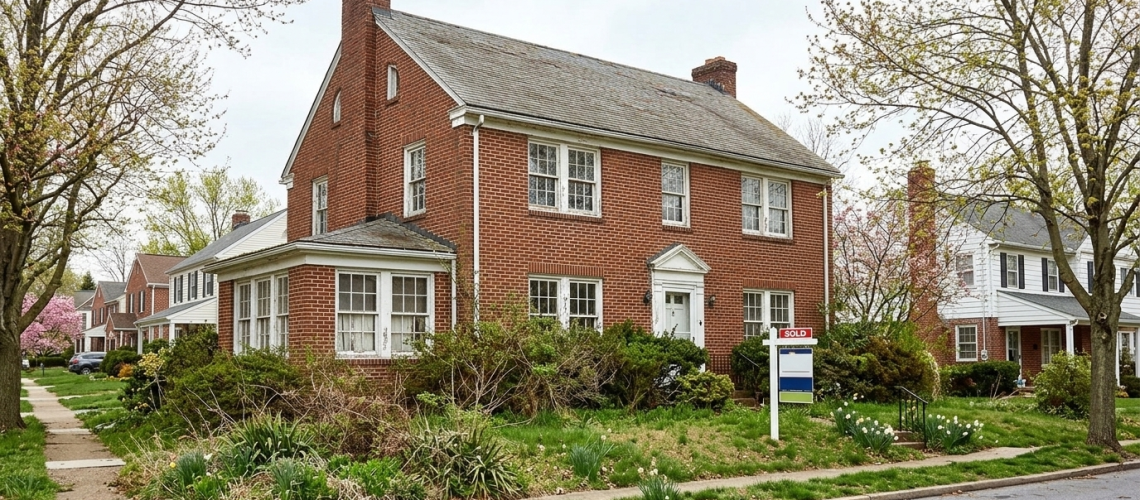
In West Chester, Garnet Valley, Unionville, and Media, $500,000 is a teardown price. Not a fixer-upper. Not a compromise. A property where the structure is functionally obsolete and the buyer's first call is often to a demolition crew. Builders understand this math and are bidding aggressively against families for the same properties — because the land value alone justifies the cost of demolition.
This is not a borough phenomenon and it is not a temporary spike. It is a district-wide, permanent reset of the price floor. The house on the lot is almost incidental. The land is the asset.
The Psychology Gap
Remote and hybrid work untethered high-earning buyers from NYC, DC, Northern Virginia, and California. They looked at Chester County and saw a quality of life they recognized at prices that felt like a time machine. A colonial in Media for $850,000 looks like an absolute steal to someone who just left a $1.5 million apartment with half the square footage.
These buyers arrive with coastal buying psychology: the asking price is the opening bid, not the destination. Pay over ask. Waive contingencies. Treat land as a finite, irreplaceable asset. They aren't being reckless — they are applying the only framework they know. But when that framework collides with a local buyer who is stretched to meet the asking price, it isn't a negotiation. It's a mismatch. The typical gap between a coastal offer and a local offer is $50,000 to $100,000 over asking. The local buyer simply cannot follow.
The $12 Million Proof Point
One listing. $930,000 asking price. Thirteen offers. Buyers who bid $985,000 — $55,000 over asking — lost. Twelve sets of buyers, each wielding roughly $1 million in purchasing power, walked away from that single weekend empty-handed. That is $12 million in pre-approved, motivated, ready-to-close capital that did not transact.
Those buyers didn't disappear. They are still in the market, frustrated, and that frustration sharpens the next offer. Every loss makes a buyer more aggressive. The buyer who has lost three offers is more dangerous to compete against than someone making their first bid. Multiply that dynamic across every competitive listing in Chester, Delaware, Montgomery, and New Castle counties over a spring season — the scale of frustrated, compounding capital becomes almost incomprehensible.
The Quiet Displacement
The local move-up buyer — the family who's been here for years, whose kids are in the schools, who planned to stay — is being forced into one of two options. Renting and waiting for a softening that has no structural mechanism to occur. Or buying significantly smaller than planned, accepting a home that doesn't fit the next chapter simply because the house that does is out of reach. The analysis calls this quiet displacement. No evictions. No dramatic exits. Just the slow, invisible process of families being priced into a smaller version of the life they expected in the town they've always called home.
The other side of that equation: longtime owners who bought 30 years ago for $180,000 to $280,000 are cashing out life-changing generational equity in a single transaction. Frustration, resignation, and quiet optimism exist simultaneously on the same street.
Why Nothing Fixes It
The constraint on this market is not buyer demand or borrowing costs. It is land. The premium school districts driving this shift are already largely built out. There are no large tracts of buildable land left in the most desirable areas. When interest rates drop, they don't rebuild inventory — they bring more buyers into a market that already has too few homes, intensifying bidding wars rather than relieving them.
New construction in New Castle County, Downingtown, and the Great Valley corridor doesn't solve it either — for two reasons. First, it costs more than comparable resale; new construction is a parallel expensive market sitting above the resale floor, not a relief valve below it. Second, buyers in these markets prefer established neighborhoods. New construction delivers a house. Resale delivers a place — mature trees, walkable streets, community identity. The frustrated capital stays in the resale pool. The system is closed. The floor holds.
What Local Buyers Can Actually Do
Strategy has to replace hope. Understand the psychology of the competition — a coastal relocator's offer isn't just a number, it's a completely different philosophy on the value of dirt. Use OfferEdge to structure offers around what actually wins in this environment: terms, timing, and certainty alongside price. Accept the new baseline reality of the market you are actually in, not the market you remember from five years ago. The buyers who win are the ones who adjust first.
Listen to the Full Discussion
The full episode walks through every dimension of this shift — the complete coastal psychology breakdown, the $12 million proof point in full detail, the quiet displacement analysis, the new construction closed loop, and the Columbo questions designed to surface the blind spots that cost local buyers the most. Listen or read the full transcript here.
For weekly market data across 41 school districts, visit our Market Intelligence Tool.
Questions About Buying or Selling in Chester County?
Whether you're a local buyer trying to compete, a longtime owner thinking about your exit, or a family relocating to the region — every situation is different. We're here to talk through what the data says and what strategy looks like in the market you're actually in.
We'll personally respond within a few hours. No autoresponders, no sales team — just us.
Or call (484) 259-7910